




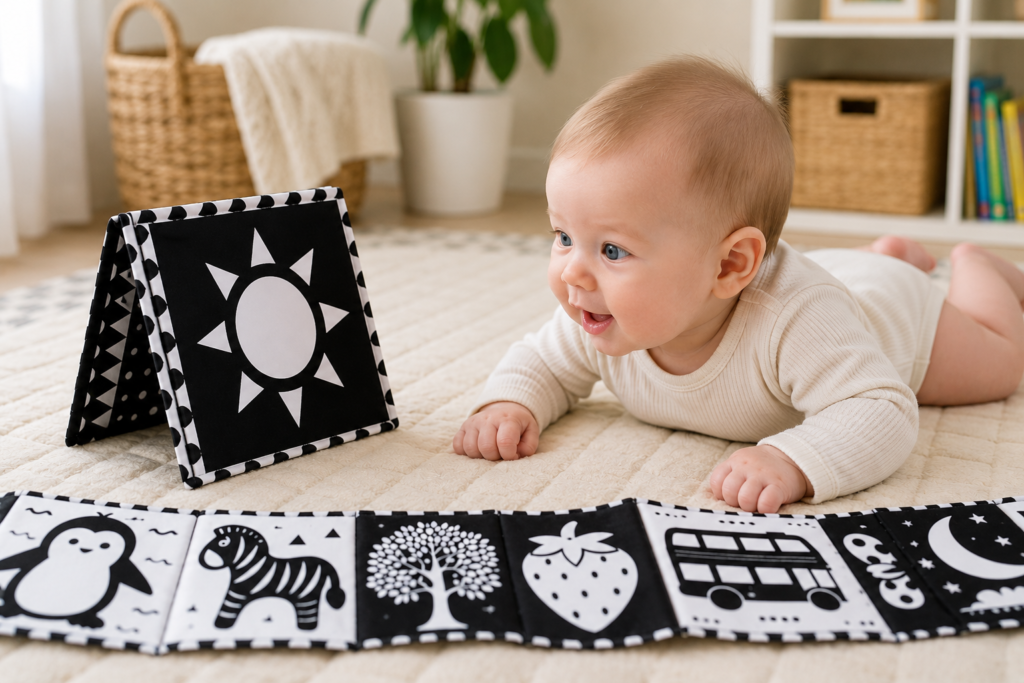
Tummy time has a reputation problem. Everyone tells you to do it, nobody tells you what to actually do once your baby’s face-down on a blanket, mildly unimpressed. This fixes that.
Newborns can’t see color well yet, but they can see bold black-and-white contrast from surprisingly early on. Prop a high-contrast card upright about 8-12 inches from your baby’s face during tummy time and instead of staring blankly at a blanket, they’ve got something to actually focus on. This gives them a reason to lift their head and hold it up a little longer each time.
This isn’t flashcards in the “teach your baby to read” sense. It’s simpler than that. It’s just giving an infant’s still-developing eyes something worth the effort of looking at, which happens to also be exactly what motivates them to build the neck and back strength tummy time is supposed to build in the first place.
Keep sessions short — a few minutes is plenty at this age. Once basic card-watching gets old, here’s where the same set turns into a few different ways to use tummy time — see “Extend the Play” below.
A note on safety: always supervise tummy time directly, and never leave a baby alone with cards or any object nearby, even briefly.
This post contains affiliate links. If you shop through them, Parent + Play may earn a small commission at no extra cost to you. Read our full disclosure.
Use What You Already Have:
- A blanket or mat on the floor
Buy One Thing: High-Contrast Baby Cards, Tummy Time Set Get it on Amazon
Adapt It (Younger/Older):
For a very young newborn, keep sessions to just a minute or two and hold the card closer, since their visual focus range is shorter. For an older infant closer to sitting up, prop the card farther away and let them work a little harder to track it as they lift and turn their head.
Extend the Play:
1. Slow pan: Gently move a card side to side about a foot away and watch them track it with their eyes.
2. Peekaboo card: Hide a card behind your back, then reveal it and pause — many babies will visibly anticipate it after a few rounds.
3. Mirror moment: If your set includes a mirror card, prop it up so they can "meet" their own reflection.
Questions to Ask:
"Can you find the card with your eyes?"
"Is your head getting a little higher today?"
"What do you see when I move it this way?"
Activity Type: Sensory Play
Age Range: Infant
Effort & Budget: Five-Minute Setup One-Purchase Activities
Skill/Developmental Focus: Gross Motor Sensory Processing